

Understanding the Strategic Difference and Why Your Organization Needs Both
Internal Audit and External Audit are often mentioned together, yet they serve fundamentally different purposes within an organization.
Many business owners, board members, and even finance professionals mistakenly assume that the two functions overlap or can substitute one another.
They cannot.
A simple way to think about it:
- External Audit checks the report card.
- Internal Audit helps you pass the exams.
Both are essential pillars of strong corporate governance. But one focuses on assurance of past performance, while the other strengthens the systems that determine future success.
Understanding this distinction is critical for organizations seeking sustainable growth, regulatory compliance, and long-term resilience.
What Is External Audit?
External Audit is an independent examination of an organization’s financial statements.
Its primary objective is to provide assurance to shareholders, regulators, lenders, donors, and other stakeholders that the financial statements are fairly presented in accordance with applicable accounting standards.
External auditors:
- Review financial records and supporting documentation
- Test transactions and balances
- Assess compliance with accounting standards
- Evaluate internal controls relevant to financial reporting
- Issue an independent audit opinion
External Audit focuses primarily on historical financial information.
It answers one key question:
“Do the financial statements present a true and fair view?”
External Audit enhances credibility and protects stakeholder confidence. However, its scope is limited to providing assurance, not managing the business.
What Is Internal Audit?
Internal Audit is an independent, objective assurance and advisory function designed to add value and improve an organization’s operations.
It helps an organization accomplish its objectives by bringing a systematic and disciplined approach to:
- Risk management
- Control effectiveness
- Governance processes
- Operational efficiency
Unlike External Audit, Internal Audit is future-focused.
It strengthens the systems that determine whether strategic objectives will be achieved.
The Core Differences between Internal and External Audit
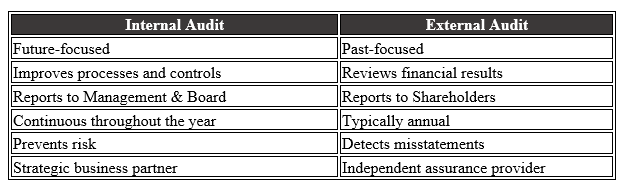
Both are important, but they serve different stakeholders and strategic objectives.
The Strategic Value of Internal Audit
Modern organizations operate in increasingly complex environments:
- Regulatory changes
- Cybersecurity threats
- Fraud risks
- Supply chain disruptions
- Rapid technological transformation
- Governance expectations
In this environment, Internal Audit is no longer a “compliance police” function.
It is a strategic risk management partner.
Let us examine the deeper value Internal Audit provides.
- Strengthening Risk Management Frameworks
Every organization faces risks, financial, operational, legal, technological, reputational, and strategic.
Internal Audit evaluates whether risks are:
- Properly identified
- Appropriately assessed
- Effectively mitigated
- Continuously monitored
A mature Internal Audit function supports enterprise risk management by ensuring that risk controls are not merely documented, but functioning effectively in practice.
This reduces surprises and protects long-term sustainability.
- Improving Operational Efficiency
Internal Audit goes beyond identifying control weaknesses.
It examines processes end-to-end and asks:
- Are there redundancies?
- Are there bottlenecks?
- Are controls overly complex?
- Are resources being used optimally?
By identifying inefficiencies and recommending process improvements, Internal Audit enhances productivity and cost-effectiveness.
This translates directly into improved financial performance.
- Preventing Fraud and Misconduct
Fraud prevention is not achieved through external audits alone.
Internal Audit plays a proactive role in:
- Evaluating segregation of duties
- Assessing authorization controls
- Reviewing procurement processes
- Monitoring high-risk transactions
- Testing compliance with internal policies
By strengthening internal control environments, organizations reduce exposure to fraud, corruption, and financial losses.
Prevention is always less costly than remediation.
- Supporting Corporate Governance
Strong governance requires reliable information and independent oversight.
Internal Audit provides Boards and Audit Committees with:
- Independent assessments of management controls
- Insight into emerging risks
- Assurance on compliance
- Evaluation of policy effectiveness
This enables better oversight and more informed strategic decision-making.
Without Internal Audit, Boards often rely solely on management representations — which increases governance risk.
- Enhancing Financial Reporting Reliability
While External Audit verifies financial statements annually, Internal Audit strengthens the systems that generate financial data.
A strong Internal Audit function:
- Improves accounting processes
- Identifies reporting weaknesses early
- Reduces year-end audit adjustments
- Supports timely financial reporting
This leads to smoother external audits and potentially lower audit costs.
Why Internal Audit Is Essential for Growing Organizations
SMEs and mid-sized enterprises assume Internal Audit is only for large corporations.
This is a misconception.
In reality, growing organizations face heightened risks because:
- Processes are evolving
- Roles are expanding
- Systems are scaling
- Governance structures are developing
Without structured internal oversight, growth can create control gaps.
Internal Audit ensures growth does not outpace governance.
Outsourced Internal Audit: A Practical Solution
Not every organization requires a full in-house Internal Audit department.
Outsourced Internal Audit provides:
- Cost efficiency
- Access to specialized expertise
- Independence from internal bias
- Flexibility based on risk profile
This is particularly beneficial for:
- SMEs
- NGOs and donor-funded entities
- Financial institutions
- Family-owned businesses
- Rapidly scaling startups
Outsourcing ensures professional oversight without the fixed cost burden of permanent staff.
At Aura & Co. CPA, we provide outsourced Internal Audit services designed to create measurable impact.
Our approach is not checklist-driven.
It is strategic, risk-based, and business-focused.
We work closely with management and Boards to:
- Conduct comprehensive risk assessments
- Review and strengthen internal controls
- Improve operational processes
- Evaluate governance structures
- Enhance compliance frameworks
- Implement continuous monitoring systems
Our Internal Audit engagements are structured to deliver actionable recommendations — not theoretical reports.
We prioritize practicality, clarity, and measurable improvement.
Our Differentiated Approach
Unlike External Audit, which is compliance-oriented, our Internal Audit team is intentionally structured to understand your business operations deeply.
We:
- Study your industry environment
- Analyze your operational workflows
- Understand your strategic objectives
- Align audit procedures with risk exposure
This ensures Internal Audit becomes a partner in performance, not merely an observer.
Moving From Detection to Prevention
The fundamental distinction between External and Internal Audit can be summarized simply:
External Audit detects issues after they occur.
Internal Audit prevents issues before they escalate.
Organizations that rely solely on External Audit operate reactively.
Organizations with strong Internal Audit functions operate proactively.
The difference is not just technical.
It is strategic.
Conclusion: Strengthen Today, Secure Tomorrow
In today’s risk environment, organizations cannot afford weak internal systems.
Strong Internal Audit functions:
- Protect assets
- Enhance governance
- Improve operational efficiency
- Strengthen risk management
- Support sustainable growth
External Audit builds credibility with stakeholders.
Internal Audit builds strength within the organization.
Both are necessary.
But Internal Audit is what ensures long-term resilience.
Partner With us
If your organization is seeking to:
- Strengthen internal controls
- Improve risk oversight
- Enhance governance
- Reduce operational inefficiencies
- Prepare for regulatory scrutiny
Aura & Co. CPA is ready to support you.
Contact us today: 0769 111 000
Strengthen your systems before risks become losses.
Build resilience before challenges arise.
Move from detection to prevention.